A Negros cemetery tour may not be a usual tourist activity but with a very knowledgeable local guide, you would be surprised of the things you will learn about the history and people of Negros Occidental. A guided Negros cemetery tour is a great way to learn more out about the mausoleum architecture, stories and urban legends about prominent clans in Negros Occidental.

Here are the things I learned from touring the Bacolod Public Cemetery, Silay Public Cemetery, and other private cemeteries.
Negros Cemetery Mausoleum Architecture
Death is the ultimate equalizer. No matter what your status in life, you eventually die. But the manner and the place in which one is buried are far from equal. You would know the difference between the statuses of the man whose grave was simply marked from the one who has an elaborate mausoleum.
Negros Occidental has probably no grand turn of the century cemetery but the affluence that the sugar industry brought to the province is very evident in the grand mausoleums built to house the remains of prominent Negrense families. These mausoleums are testaments of how they lived.
Cemeteries are rich resources of different styles of architecture as shown in the elaborate tombs and mausoleums. Although some of the rich families transferred the remains of their family members to modern cemeteries in the city, some of the mausoleums are still left intact.
Jayme-Gamboa Mausoleum
The Jayme-Gamboa Mausoleum was where Tana Dicang was temporarily buried during the war. It is located at the Northwest corner of Burgos-Lopez Jaena Sts. Though I’m not an expert on this one, my guess is, the architecture style of the mausoleum is Baroque. It is said that it still has the remains of Antonio Jayme, first elected Vice Governor of Negros Occidental, kept in a glass casket which is visible if you get inside the mausoleum.

Lopez Mausoleum
At the Southeast corner of Burgos-Lopez Jaena intersection is the Lopez Mausoleum. The architecture is unmistakably Art Deco with its lines and rectangular designs. According to the caretaker, the family has already transferred the rest of remains of their family members to a memorial in Bacolod. It still has a charming glass window, although with some broken glasses already.


Yulo Mausoleum
One of the oldest mausoleum at the Bacolod Catholic Cemetery was that of the Yulo family where the late governor Alfredo Yulo was interred. It’s architecture is also Art Deco with a Iron Cross on top. What’s interesting about this mausoleum is its massive iron door which will remind you of those vampire movies.

Lizares Mausoleum
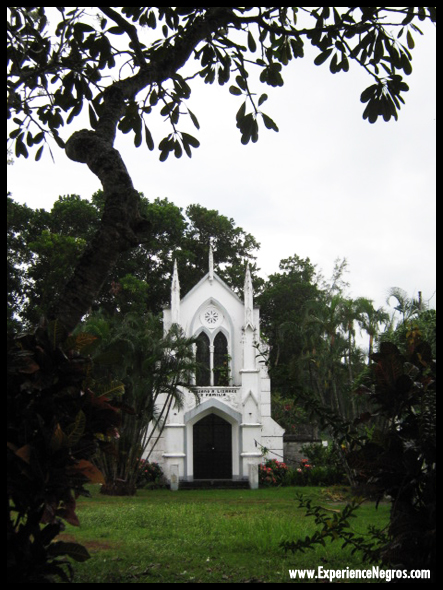
The sons of Tana Dicang built grand residences so it is only fitting that their mausoleums would also follow in this tradition. The Neo-Gothic mausoleum of her son Emiliano Lizares at the Lizares private cemetery in Talisay is just as grand as the mansion he built in Iloilo City. It is the only Neo-Gothic mausoleum I’ve seen so far were mostly were Art Deco. The white structure is quite a sight with its pointed doors, windows and pinnacles.
Ayco Mausoleum
Nestled between the Bacolod Public Cemetery and Catholic Cemetery is one of the most imposing mausoleums in Bacolod, Leon and Encarnacion Ayco mausoleum. Based on the inscriptions, this Art Deco mausoleum was built in 1939. Each corner of its massive column has an angel in different positions and holding a different item. It should have been quite a site if it was all lighted up. Inside this gated private cemetery are also tombs of other relatives. As expected, they were among Negros’ prominent clans as well.

Negros Cemetery Statues: Silent Witnesses of Grief
If only the statues could speak, I’m sure they have so much to tell us about the person whose grave they watched over. They are silent witnesses of the grief of those left behind.

The Silay Public Cemetery has so many interesting gravestones and statues. Some statues clearly convey grief that you don’t need to know the stories of the departed to empathize with the family.
They say no parent should bury their child for the pain is so unbearable. One of the tombs we saw in Silay that immediately caught our attention was placed on a pedestal at the center of a family burial ground. You don’t need to know how this boy died in order to feel the anguish of his family. Just look at how the statue is leaning on his tomb like a grieving mother and you’ll feel how his family must have felt.

This particular tomb belongs to the uncle of Solo Locsin. Julio Cesar died of tuberculosis in 1925 when he was only four years old. Solo told me that his grandfather was so stricken by grief that he had the boy mummified. Every All Saints Day, Julio’s sisters would change his clothes. However in the 1950s, the family moved his body to a permanent crypt when it was attacked by ants. Solo added that his grandfather also commissioned sculptor Guillermo Tolentino to create a metal bust of Julio Cesar which is still in the possession of the family.
I don’t think they make statues like these anymore. Perhaps it is no longer practical to do so. It might already be a bygone era but I just hope the families will keep these statues for they are cultural treasures themselves.
Epitaphs and Epithets of a Bygone Era
Tombstones not only tell us of the birth and death of the person but sometimes give us a glimpse of how he lived and how he died, through his epitaph.
Going around Silay’s Public Cemetery was quite a revelation. Tombs built during a certain period display some similarities. There was a period where only the names of the departed were written on the tombstones. There were tombs which were elevated with epitaphs still written in Spanish.
These are some of the epitaphs which I hope was translated correctly through an online Spanish Dictionary.
Ester! Desde el lugar donde te halles contempla a tus padres que lloran por tu muerte.
Ester! From the place where you are, watch your parents cry for your death.
Ester’s tomb was at the lowest part of a family burial “condominium” already on it’s third level so she must have died a long time ago. There’s no family name on her tombstone but since she’s buried with her family, you don’t have to guess. There’s also no birth nor death dates so we don’t know how old she died. However, there were several tombstones without family names like Ester’s whose owners died in the 1920’s.
Traidoramente arrebatada de los brazos de su familia por la implacable parca, el 25 de Diciembre 1910. Ofrenda de su esposo e hijos.
Treacherously snatched from the arms of her family by the relentless reaper, on 25 December 1910. Offering from her husband and sons.
Volo a la Gloria con intense pesar de sus padres el 11 de Junio de 1910 a la muy tierna edad de dos año. Sus padres depositan sus mas acerbas lagrimas ante la tumba del hijo querido.
Flew with glory to the intense grief of his parents on June 11, 1910 at the very tender age of two. His parents put their bitter tears at the grave of their beloved child
The first tomb’s owner died on Christmas day which must have been doubly painful for the family. These two tombs belong to one family and they both died a century ago. Was it just coincidence or they both died of an epidemic? We don’t know for sure but these epitaphs gave us a glimpse into their deaths and the grief of their families.
Most of today’s tombs are simply marked “Family Remembrance” or sometimes with a verse from the Bible. I think those we saw in Silay has more drama. They make you think of the story of the departed.
Unearthing Stories and Urban Legends
Aside from their elaborate mausoleums, prominent Negrense families likewise have interesting stories related to their burial grounds. Although there are some juicy scandals that echoed through the hallowed mausoleums of some families, these are not fit for printing. Besides, it is Filipino tradition not to speak ill of the dead. Let their secrets remain in their graves. What we have here are the not-so-secret stories and urban legends which some people may not have heard of.
Luzuriaga Family Cemetery
The Luzuriaga cemetery albeit simple, is perhaps the most interesting of all cemeteries in Negros. Who wouldn’t be amazed of this cemetery at the center of the street? It is said to be the only one of its kind in the world and it has landed in the Guinness Book of World Records for being the only cemetery in the middle of the street. This however turned out to be untrue since no such record exist in the Guinness.

It is said that when Lopez Jaena St. was being constructed, it is going to pass through the Luzuriaga family cemetery which means they have to transfer the graves. The Luzuriaga family made a bargain, or should I say reminded, the city government that they donated the lot which is where the old city hall is located. In return of their generosity, the city government left alone the family cemetery and constructed the street on both sides of the cemetery. This left some family mausoleums on the opposite streets separated from the public cemetery.
The Sangguniang Panlungsod of Bacolod City approved on first reading on September 2022 the proposed ordinance declaring the Familia Luzuriaga Mausoleum as a heritage site and tourist destination.
Lizares Family Cemetery
The Lizares family, one of the prominent families in Negros has their own cemetery in Talisay City. Different branches of their family are mostly buried there so All Souls Day is probably a big family reunion. Some locals call it “lulubngan sg manggaranon” (cemetery of the rich) because of the prominent families buried there.

The Lizares’ late matriarch, Tana Dicang, died during the war and was temporarily buried at the Jayme-Gamboa family mausoleum in Bacolod City. She later had her proper burial at the Lizares burial ground where she is now buried beside her husband Efigenio. Their tombs were placed on a pedestal, looking down on all the tombs and mausoleums of their sons and daughters.
Mariano and Aniceto Lacson
The Lacsons, Lizares’ political rivals in Talisay, still make history even in death. The remains of Mariano Lacson and his first wife Maria Braga were interred inside the San Nicholas Church in Talisay City. As it is, Mariano must have loved his first wife so much that he built a grand mansion (Ruins in Talisay) in her memory and he was also buried right next to her.

On the other hand, Aniceto Lacson, brother of Mariano and President of the short-lived Cantonal Republic of Negros, was also interred at San Nicholas Church. When he died in 1931, his remains were buried in his hometown Molo, Iloilo City.

However, because of his contribution to Negros,his children had his body exhumed and interred at the San Nicholas Church where it is located to this day.
Melecio Severino
Melecio Severino was the first elected governor of Negros and was also a representative to the Philippine Assembly. His tomb was placed conspicuously in front of the entrance of the Silay Public Cemetery. I’ve only learned recently from a Silaynon that there is an urban legend that his body apparently got lost when it was transferred from one grave to another and nobody can pinpoint its exact location. He died in Manila and so the family moved his remains several times. It was said that the contents of his tomb in Silay was that of his encargado. But then again, this is just an urban legend which may not be entirely true.

I’m sure there are still more stories out there, either truth or chismis, that are just waiting for us to uncover. A tomb is just a stone but the life and in some cases, the death, of the person buried in them makes you look at it from a different perspective.
Interested in doing a Negros cemetery tour? Just get in touch with the Negros Occidental Tourism office so they can provide you with a knowledgeable local guide. https://web.facebook.com/negrosoccidentaltourismcenter


Glady, even more blessed of being a negrense after reading your posts. I thank God for your passion in travelling, exploring of His great creations and for your love on writing. 🙂 Keep it up!! 🙂 Have a blessed Christmas.. 😀
Who will handle the VBA Tour? 🙂
Btw,will the group join the VBS 2011 in Cebu? I haven’t book my ticket though.
Let me know what I can do to help in with the VBA 2011. I’m all tied-up at work for now.
Regards,
Vir
Ver Pacete will be handling the tour. He’s the Tourism Officer of Silay City. Yes, I think other Negros Bloggers will be joining. Just help us promote the event. 😀
Great stories indeed!
I wonder if we can include the cemetery for the day tour during the VBA 2011? Crazy idea!
Not crazy at all. Although it’s not for everybody. In New Orleans they make money from cemetery and witchcraft tours. This will not be included in VBA 2011 tour but we can have it one time with our group. It will be more interesting if we have somebody from Silay to tour us.
and im back! hehe
enjoyed this post and the one with the mausoleums. lessons in art, architecture, heritage
and history all in two posts. proud negrense ka na gid? hahaha good job!
Thanks day! I’m touched, really. I know how seldom you give compliments. hehehe
Hi Glady, you have a typo on those dates somewhere up there. 🙂 .. Keep up the good work.. 🙂
Already corrected the typo. Thanks! 😀
You have a wonderful gift for looking at the ordinary and seeing something extraordinary in it. I hope you continue looking at our city and then share your insights and musings with us through this wonderful blog.
Thank you my dear Bambi. You guys are actually a big influence and I’ve learned so much about Negros history and society from the group. Still, there’s a lot to discover.
Enjoyed this write-up and the pictures, Glady. Keep writing and telling the world about Negros. As a Negrense, i thank you.
Thanks for always taking time to read my posts and for the encouragement.